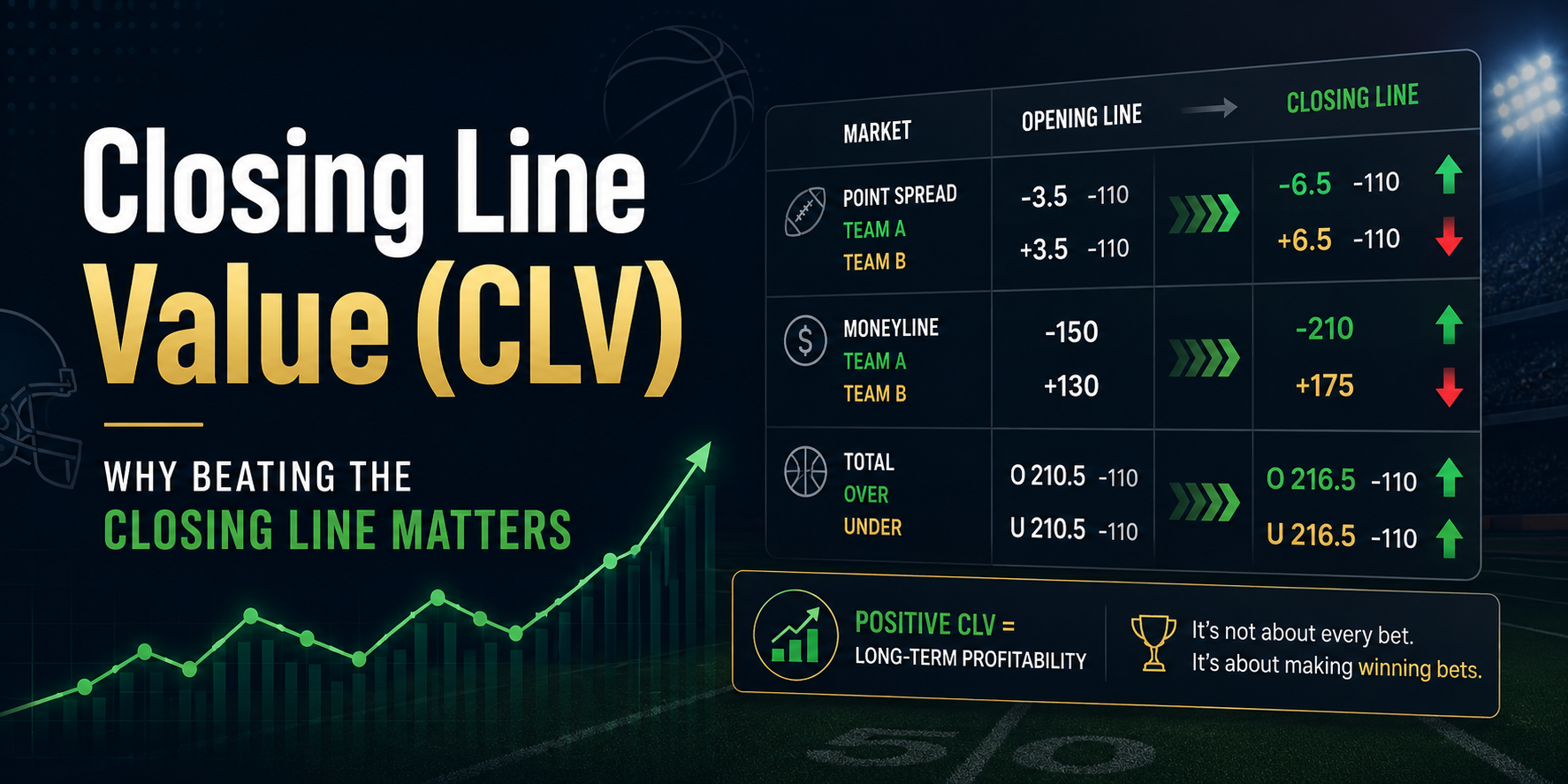
What Is Closing Line Value (CLV) in Sports Betting?
Closing line value, usually abbreviated CLV, measures how the price you received on a sports bet compares with the market's closing price.
In simple terms: Did you get a better betting number than was available when the market closed?
If you bet a team at +140 and the same team closes at +115, you received the better price. That is positive closing line value.
If you bet the team at +140 and it later closes at +160, the market moved against your position. That is negative closing line value.
CLV does not tell you whether an individual wager will win. A bet with excellent closing line value can still lose easily. Instead, bettors track CLV because it provides another way to evaluate the quality of the price they obtained independently of the final game result.
What Does CLV Mean in Sports Betting?
CLV stands for Closing Line Value.
The closing line is the market price available near the start of an event. Your closing line value measures the difference between the price at which you made your wager and the price at which the same market eventually closed.
For example:
Your bet: Chicago +150
Closing line: Chicago +125
Your +150 ticket is more valuable than buying the same outcome at +125. You received a larger potential payout for essentially the same event. That is positive CLV.
Positive CLV Example
Suppose you bet Baltimore +135. Several hours later the market moves. At game time Baltimore is +110.
You still own your original +135 ticket. If Baltimore wins, a $100 wager at +135 earns $135 in profit, while a bettor entering at the closing price of +110 earns only $110.
You obtained a superior price. That does not make Baltimore more likely to win after you placed the bet. It means the market eventually valued Baltimore more highly than it did when you entered.
Negative CLV Example
Now suppose you bet Baltimore +135, but the market closes at Baltimore +160.
The later market is offering a better price than you received. Your +135 ticket is therefore less attractive than the closing +160 price. That is negative CLV.
Again, Baltimore could still win. CLV evaluates the price, not the outcome.
Why Does Closing Line Value Matter?
Sports betting outcomes contain substantial randomness. A bettor can make a strong wager and lose. A bettor can make a poor wager and win.
That makes it difficult to judge the quality of a betting process using short-term wins and losses alone. Closing line value gives bettors another piece of information.
If someone consistently obtains better prices than the market eventually closes at, it suggests that his or her wagers are repeatedly being made before the market moves in the same direction.
That can be useful when evaluating whether a betting process is identifying favorable prices. CLV should not be treated as proof that someone will make money, but over a sufficiently large sample it can be a useful companion to ROI, units won, average odds, win rate, sample size, and maximum drawdown.
The Closing Line Is a Benchmark, Not a Guarantee
Sports betting markets usually incorporate information as game time approaches. That information can include injuries, starting lineups, weather, starting pitchers, player availability, betting activity, market-maker adjustments, changes at competing sportsbooks, and increasing betting limits.
By closing time, more information may have been incorporated into the market than was available when the line originally opened. For that reason, bettors often use the closing line as a benchmark.
But the closing price is not perfect. Markets can still be wrong, and different sportsbooks can close at different prices. The closing line should therefore be viewed as a useful market reference point rather than an infallible estimate of true probability.
CLV vs. Winning the Bet
This distinction is critical.
Suppose you bet Team A +150 and the market closes at Team A +110. You have positive CLV.
Team A then loses 8-2. Was the CLV still positive? Yes.
The result of the game does not retroactively change the price you obtained. Your wager lost money, but you still entered the market at a substantially better price than someone betting the same side near closing time.
The reverse can also happen. Suppose you bet Team B -150 and the market closes at Team B +105. That is terrible closing line value. But Team B wins the game.
You made money. The winning result does not change the fact that the closing market eventually offered a much better price than the one you accepted.
This is why result quality and decision quality are not always the same thing.
How Do You Calculate Closing Line Value?
There are several ways bettors discuss CLV. The simplest approach is to compare the betting prices directly.
For example:
Bet price: +140
Closing price: +115
It is obvious that +140 is the superior ticket.
Likewise:
Bet spread: +3.5
Closing spread: +2
The bettor who took +3.5 obtained a better number.
For basic tracking, simply recording your betting line and the closing line can provide useful information.
Calculating CLV With Decimal Odds
A simple price-based comparison can also be made using decimal odds.
Suppose you bet +120, which converts to decimal odds of 2.20. The market closes at +100, or decimal odds of 2.00.
A simple relative-price comparison is:
2.20 ÷ 2.00 - 1 = 10%
Under this simple method, your ticket provides roughly 10% more payout value relative to the closing price.
However, this is not necessarily the same thing as a fully de-vigged estimate of betting edge.
A More Precise CLV Method
A more analytical method is to estimate the market's fair closing probability after removing sportsbook vig.
Once you estimate the no-vig closing probability, you can compare that probability with the price you originally received.
One useful framework is:
CLV = Bet Decimal Odds × Fair Closing Probability - 1
Suppose you obtained decimal odds of 2.20 and the no-vig closing market suggests a fair probability of 47.7%.
Then:
2.20 × 0.477 - 1 ≈ +4.9%
This approach is more sophisticated because it attempts to account for the sportsbook margin embedded in the closing odds.
For most bettors, however, consistently recording the price they took and the closing market price is already a major improvement over tracking only wins and losses.
Why You Should Remove the Vig for Precise CLV Analysis
Sportsbook odds contain margin.
Suppose a market closes:
Team A -110
Team B -110
The raw implied probabilities are approximately:
52.38% + 52.38% = 104.76%
Both teams obviously cannot have a combined true probability of 104.76%. The excess represents the sportsbook's pricing margin.
If you want to use the closing market as an estimate of fair probability, you should ideally remove that margin first. This is often called removing the vig, de-vigging, calculating no-vig probability, or calculating fair odds.
Moneyline CLV Example
Suppose you bet an MLB underdog at +155 and the same team closes at +125.
Your ticket offers substantially more upside than the closing price. A $100 winning wager at +155 earns $155. At +125, it earns $125.
You secured $30 more potential profit on the same $100 risk.
Favorite CLV Example
CLV applies to favorites as well.
Suppose you bet -120 and the line closes at -155. Your -120 price is better.
At -120, you risk $120 to win $100. At -155, a bettor entering later must risk $155 to win the same $100.
With favorites, the better number is generally the less expensive negative price.
Point Spread CLV
CLV is not limited to moneylines.
Suppose you bet Dallas +3.5 and the market closes at Dallas +2. Your +3.5 ticket is better.
If Dallas loses by exactly 3, your +3.5 bet wins while the closing +2 bet loses.
Half-points and full points can therefore have real value, particularly around common scoring margins in sports such as football.
Total CLV
The same concept applies to totals.
Suppose you bet Over 44 and the market closes at Over 46.5. You obtained the better number for an Over wager.
If the game finishes with 45 points, your Over 44 wins while the closing Over 46.5 loses.
For an Under bettor, the relationship works in the opposite direction. If you bet Under 48 and the market closes at Under 45, your Under 48 ticket has positive line value relative to the close.
Is CLV More Important Than Win Rate?
They measure different things.
Win rate tells you how often the wager won. CLV asks how your betting price compared with the eventual market price.
Neither should automatically replace the other. A proper betting evaluation can consider win rate, average price, ROI, units, closing line value, and sample size.
A 60% win rate means little without knowing the prices involved. Likewise, positive CLV without actual profitability over a very large sample deserves further investigation rather than blind confidence.
CLV vs. Sports Betting ROI
ROI measures actual financial performance:
ROI = Net Profit ÷ Total Amount Wagered × 100
Closing line value measures the quality of your entry price relative to the closing market.
It is possible to have positive CLV and negative ROI during a losing stretch. It is also possible to have negative CLV and positive ROI temporarily because of favorable outcomes.
Over small samples, randomness can dominate both measures. This is why neither CLV nor ROI should be interpreted without sample size.
For a detailed explanation of profitability measurement, read our guide to sports betting ROI.
Can Positive CLV Guarantee Long-Term Profit?
No.
A closing line is still only a market price. Markets are highly competitive, but they are not infallible.
Choosing the correct closing reference also matters. A soft recreational sportsbook may not provide the same information as a highly liquid market-making book.
Bet type matters too. A major NFL point spread may have an extremely informative closing price. A niche player prop at a small sportsbook may not.
Finally, sample size matters. Twenty wagers with strong CLV do not establish much.
CLV is most informative when tracked consistently across a substantial number of comparable wagers.
Which Closing Line Should You Use?
Ideally, use a consistent reference.
Possible choices include the same sportsbook where you placed the wager, a market-making sportsbook, a consensus closing line, or a defined source used consistently across your betting database.
The important thing is consistency.
If you choose whichever closing sportsbook makes each individual wager look best, your CLV record becomes meaningless. Define the methodology before examining the results.
What Time Counts as the Closing Line?
The closing line generally refers to the final available price immediately before the event begins.
However, exact timing can vary by sport and data provider. For practical tracking, use a consistent close definition, record it systematically, and avoid selectively choosing timestamps after seeing how the market moved.
For games with late scratches or starting lineup changes, prices can move rapidly near start time. That makes consistent data collection particularly important.
CLV and Line Shopping
Line shopping can directly improve closing line value.
Suppose three sportsbooks offer:
Book A: +115
Book B: +125
Book C: +135
You like the same team regardless. Choosing +135 gives you a much better starting position.
If the entire market later closes around +110, Book C produced considerably better value than Book A.
The handicapping opinion did not change. Only the price did.
CLV and Timing the Market
Closing line value is also closely related to market timing.
Some betting opportunities may be strongest early. Others may improve later.
For example, you might expect a popular favorite to become more expensive closer to game time, an unpopular underdog to receive a better price later, weather information to move a total, or a confirmed starting lineup to move a player prop.
There is no universal rule that betting early is always better. The goal is to understand when the market is most likely to offer favorable prices for the type of wager you are making.
Does Reverse Line Movement Equal Positive CLV?
Not necessarily.
Reverse line movement refers to a market moving against the side receiving more public betting activity.
Suppose 70% of reported bets are on Team A, but the line moves toward Team B. That movement may be interesting.
But it does not automatically mean sharp bettors caused the move, Team B is a good bet, or Team B will have positive CLV if you bet now.
CLV should be measured using the price you actually obtain relative to the eventual closing price. It should not be inferred simply from public betting percentages.
CLV and Sharp Money
Sharp bettors are often associated with beating closing lines because sophisticated market participants tend to care deeply about price.
But the phrase sharp money can be overused.
A market move can result from professional betting, injury news, market-maker adjustments, arbitrage, limits changing, another sportsbook moving first, public information, or book-specific liability.
Rather than trying to label every move as “sharp,” it is often more useful to track exactly what happened to the price.
Why One Bet Tells You Almost Nothing About CLV Skill
Suppose you bet +150 and it closes +110. Excellent CLV.
That does not prove you are a skilled bettor. You might simply have been lucky about when you entered.
The important question is whether the pattern repeats.
Across hundreds of wagers, you can begin asking:
- How often do I beat the close?
- By how much?
- Which sports produce the strongest CLV?
- Which bet types produce negative CLV?
- Does positive CLV correspond with better ROI?
- Do certain sportsbooks consistently offer better entry prices?
That turns CLV into a useful analytical tool.
How to Track Closing Line Value
A betting log should ideally include:
- Date
- Sport
- Event
- Selection
- Bet type
- Sportsbook
- Odds taken
- Spread or total taken
- Closing odds
- Closing spread or total
- Stake
- Result
- Profit/loss
For more advanced tracking, add no-vig closing probability, calculated CLV percentage, time wager was placed, opening line, and market consensus close.
Once you have enough data, you can analyze average CLV by sport, wager type, sportsbook, month, favorite vs. underdog, early vs. late bets, and price range.
Example CLV Betting Log
| Bet | Price Taken | Closing Price | CLV Direction |
|---|---|---|---|
| Team A | +150 | +125 | Positive |
| Team B | -115 | -140 | Positive |
| Team C | +110 | +135 | Negative |
| Team D | -150 | -130 | Negative |
The goal is not necessarily for every bet to beat the close. That would be unrealistic.
The more useful question is whether your process consistently produces favorable closing comparisons across a meaningful sample.
Common CLV Mistakes
Treating CLV as a Guarantee
Positive CLV does not mean an individual wager will win.
Comparing Different Markets
A first-half line should not be compared with a full-game close. The exact wager must match.
Ignoring Vig
Raw odds include sportsbook margin. More precise CLV analysis should account for that.
Cherry-Picking the Closing Sportsbook
Choose a consistent closing source rather than selecting whichever close makes your ticket look best.
Using Tiny Samples
A handful of good closing-line moves proves little.
Forgetting the Actual Results
CLV is a process metric, not a replacement for profitability measurement. ROI and real-world results still matter.
Closing Line Value FAQ
What does CLV stand for in sports betting?
CLV stands for Closing Line Value.
What is positive CLV?
Positive CLV means you obtained a better betting price or number than the market offered near closing.
What is negative CLV?
Negative CLV means the closing market eventually offered a better price than the one you accepted.
Does positive CLV mean my bet will win?
No. Closing line value measures price quality, not the result of an individual sporting event.
Is +140 closing at +120 positive CLV?
Yes. For an underdog moneyline, +140 is a better price than +120.
Is -120 closing at -150 positive CLV?
Yes. -120 is less expensive than -150, so the bettor obtained the better favorite price.
How do you calculate CLV?
At a basic level, compare your betting odds or line with the closing odds or line. More advanced analysis converts the closing market into no-vig fair probability and compares that probability with your original price.
Is CLV better than ROI?
They measure different things. ROI measures realized profitability. CLV measures your entry price relative to the closing market.
What sportsbook should I use for the closing line?
Use a consistent reference, ideally one you define before analyzing your results. A liquid market-making book or consistently calculated market consensus can be useful.
How many bets do you need before CLV matters?
There is no magic number. Larger samples are more informative than small ones, and the required sample depends on the market and bet type. Avoid drawing strong conclusions from a handful of wagers.
Final Thoughts
Closing line value is one of the most useful concepts for bettors who want to evaluate how well they are entering betting markets, rather than simply counting wins and losses.
The basic idea is straightforward: Get a better price than the market eventually closes at.
If you consistently do that, the market is repeatedly moving toward your position after you make your wager. That is valuable information.
But CLV should remain part of a broader evaluation that includes ROI, units, sample size, average odds, market type, and recordkeeping.
A bet can have positive CLV and lose. A bet can have negative CLV and win.
The goal is not to predict the result of one game from CLV. The goal is to determine whether your betting process consistently obtains favorable prices over time.
For broader background on odds, value, market movement and performance tracking, start with our Sports Betting Education guide.
You can also join the existing StatWagering discussion: What Is Closing Line Value (CLV) and Why It Actually Matters?




WOW,Very wonderful
The content is really great