Sports Betting ROI: Formula, Examples & How to Calculate It
Sports betting ROI measures how efficiently a bettor turns money wagered into profit or loss. It is one of the most useful statistics for evaluating betting performance because a win-loss record by itself does not tell you whether someone is actually profitable.
A bettor can win 60% of bets and still lose money if the prices are too expensive. Another bettor can win fewer than half of all bets and remain profitable by consistently betting underdogs at favorable odds.
The basic sports betting ROI formula is:
ROI = Net Profit ÷ Total Amount Wagered × 100
For example, if you wagered $10,000 over a season and finished with $500 in net profit, your ROI would be +5%.
What Is Sports Betting ROI?
ROI stands for return on investment. In sports betting, ROI measures your net profit or loss relative to the total amount of money you risked.
- +8% ROI means you earned $8 in profit for every $100 wagered.
- +2% ROI means you earned $2 for every $100 wagered.
- -5% ROI means you lost $5 for every $100 wagered.
ROI makes it easier to compare bettors, systems, sports, and strategies even when they use different bankroll sizes.
Sports Betting ROI Formula
The standard formula is:
Sports Betting ROI = Net Profit ÷ Total Amount Wagered × 100
You need two numbers: your total net profit or loss and the total amount wagered across all bets.
Example
Suppose you make 100 bets at $100 each. Your total amount wagered is $10,000. If you finish with $600 in net profit:
$600 ÷ $10,000 × 100 = 6%
Your betting ROI is therefore +6%.
Negative ROI Example
If you wager $20,000 during a season and lose $1,200:
-$1,200 ÷ $20,000 × 100 = -6%
A negative ROI means the strategy lost money relative to the amount risked.
Why ROI Is Better Than Looking Only at Profit
Raw profit can be misleading because it does not account for how much money was risked to generate that profit.
Bettor A: $5,000 wagered, $500 profit, +10% ROI.
Bettor B: $50,000 wagered, $1,000 profit, +2% ROI.
Bettor B made more dollars, but Bettor A generated a much greater return relative to the amount risked. Neither statistic tells the entire story, but ROI makes efficiency easier to compare.
Sports Betting ROI vs. Win Rate
Win rate and ROI are not the same thing. This is one of the most important concepts in betting analysis.
A bettor can win 60% of wagers and still lose money if those bets are placed at expensive favorite prices. Conversely, a bettor can win fewer than 50% and remain profitable if the average winning price is high enough.
Example: Profitable With a 45% Win Rate
Imagine 100 wagers of $100 each:
- 45 wins at +150
- 55 losses at -100
Winning profit is $6,750. Losses total $5,500. Net profit is $1,250 on $10,000 wagered, producing a +12.5% ROI.
The bettor won only 45% of the bets but still generated a positive return. That is why serious analysis should examine price and profitability, not just winning percentage.
Sports Betting ROI and American Odds
The odds determine the break-even percentage required for profitability.
| Odds | Approx. Break-Even Rate |
|---|---|
| -110 | 52.38% |
| -120 | 54.55% |
| -150 | 60.00% |
| -200 | 66.67% |
| +100 | 50.00% |
| +120 | 45.45% |
| +150 | 40.00% |
| +200 | 33.33% |
These percentages explain why win rate cannot be evaluated without knowing the odds.
What Is a Good Sports Betting ROI?
There is no universal number that defines a “good” sports betting ROI. Context matters enormously.
Important factors include sample size, average odds, sport, market type, betting limits, line-shopping ability, market efficiency, and whether the results were documented at obtainable prices.
A very high ROI across 10 bets tells you almost nothing. A modest positive ROI maintained over thousands of properly documented wagers can be much more meaningful.
Sample Size Matters
+40% ROI over 12 bets may simply reflect short-term variance. By contrast, +4% ROI over 3,000 bets can provide much stronger evidence of a genuine edge.
Betting results should therefore be evaluated using both ROI and sample size.
ROI vs. Units Won
Betting records are often reported in units. A unit provides a standardized way to express bet size.
If one unit equals $100 and a bettor finishes +20 units, that equals $2,000 in profit. But the unit total alone still does not tell you how much was risked.
For example, +20 units on 200 units risked equals +10% ROI, while +20 units on 800 units risked equals only +2.5% ROI.
This is why units and ROI are best viewed together.
Flat Betting vs. Variable Bet Sizes
With flat betting, every wager uses approximately the same stake. Variable betting changes the amount risked based on factors such as perceived edge, price, Kelly Criterion, market type, or bankroll rules.
If bet sizes vary significantly, simply counting wins and losses becomes even less useful. Total dollars—or total units—risked must be included in the calculation.
How to Calculate ROI When Bet Sizes Vary
Suppose you make four wagers:
- Risk $100 and win $90.91
- Risk $200 and lose $200
- Risk $50 and win $75
- Risk $150 and win $125
Total risk is $500. Net profit is $90.91. ROI is:
$90.91 ÷ $500 × 100 = 18.18%
The denominator is the total amount risked, not the starting bankroll.
Betting ROI vs. Bankroll Growth
ROI and bankroll growth are related but not identical.
Suppose you begin with a $5,000 bankroll, wager a cumulative $30,000 during the season, and finish with $1,000 profit.
- Bankroll growth: $1,000 ÷ $5,000 = 20%
- Betting ROI: $1,000 ÷ $30,000 = 3.33%
Both numbers are correct. Bankroll growth measures how much the bankroll increased. Betting ROI measures the efficiency of all money wagered.
How Sportsbook Vig Affects ROI
Sportsbooks build a margin into betting markets. This is commonly called vig, vigorish, juice, or hold.
A standard spread market might be priced at -110 on both sides. That pricing raises the break-even point from 50% to approximately 52.38%.
A sustainable positive ROI therefore requires overcoming both market efficiency and sportsbook pricing.
Why Line Shopping Can Improve ROI
Small price differences accumulate over large betting samples.
If one sportsbook offers Team A -110 while another offers Team A -105, the difference appears small on one wager. Across hundreds or thousands of bets, routinely obtaining better prices can materially affect long-term ROI.
The same principle applies to point spreads and totals. Getting +3.5 instead of +3, or Under 47.5 instead of Under 47, can occasionally turn a loss into a push or a push into a win.
Sports Betting ROI and Closing Line Value
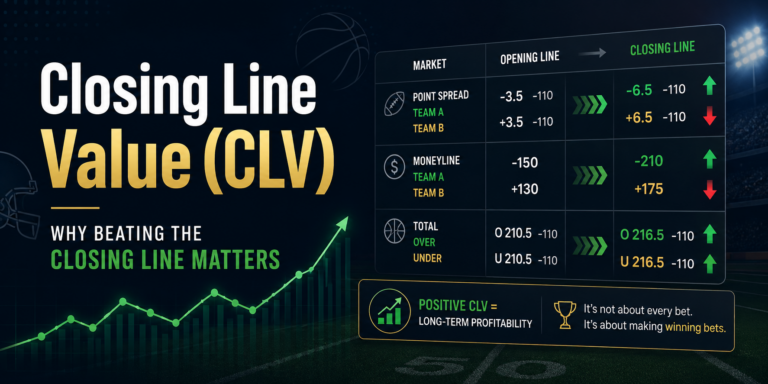
ROI tells you what happened. Closing line value (CLV) can help evaluate the quality of the prices you obtained.
Suppose you bet Team A +130 and the market closes Team A +110. You obtained a better price than the closing market. That does not guarantee the individual bet will win, but consistently beating the closing price can provide useful evidence that your process is identifying value early.
For more discussion, see StatWagering's forum guide to closing line value (CLV).
Can You Have Positive CLV and Negative ROI?
Yes, especially over a small or moderate sample. A bettor can repeatedly get better prices than the closing market and still experience a losing stretch because sports outcomes contain substantial variance.
Likewise, someone can make poor bets and experience a short-term winning streak. Over a sufficiently large sample, bettors generally want both good price quality and positive financial results.
Can You Have Positive ROI Without an Edge?
Absolutely—over a short sample. Someone can go 8-2 simply because of variance. That does not prove the bettor has discovered a sustainable advantage.
Performance should be evaluated using multiple factors:
- ROI
- Total profit
- Units won
- Number of bets
- Average odds
- Closing line value
- Maximum drawdown
- Market type
- Time period
Why Documenting Betting Results Matters
Reliable ROI requires reliable records. At minimum, a betting log should record date, sport, matchup, selection, bet type, odds, amount risked, amount won or lost, sportsbook, and—when available—opening and closing lines.
Without accurate records, it is easy to overestimate performance. People naturally remember dramatic wins more clearly than routine losses. A betting record removes that bias.
How to Track Sports Betting ROI in Units
You do not need to use dollars. Suppose your betting record contains 500 units wagered and +25 units profit.
25 ÷ 500 × 100 = 5% ROI
This makes it possible to publish or compare results without disclosing actual bankroll size.
ROI by Sport
A bettor should consider calculating ROI separately for each sport.
| Sport | Units Risked | Net Units | ROI |
|---|---|---|---|
| MLB | 400 | +24 | +6.0% |
| NFL | 150 | +12 | +8.0% |
| NBA | 300 | -9 | -3.0% |
| NHL | 200 | +5 | +2.5% |
The same analysis can be performed by moneyline, spread, total, prop, favorite, underdog, league, sportsbook, month, or betting system.
ROI by Wager Type
Different wager types can produce very different results. Someone might be strong on MLB moneylines, average on totals, and weak on parlays or player props.
If you are unfamiliar with the different markets, see our guide to the types of sports bets.
Why Parlays Can Distort Betting Results
Parlays create larger swings in both directions. A single winning multi-leg parlay can temporarily make an overall record look exceptional, while repeated parlay losses can heavily drag down ROI.
For meaningful analysis, it can be useful to separate straight-bet ROI, parlay ROI, same-game parlay ROI, and futures ROI.
ROI and Expected Value
ROI is historical. Expected value (EV) is forward-looking.
ROI asks: What return did these bets actually produce?
Expected value asks: What return should this wager theoretically produce given the estimated probability and price?
An individual positive-EV wager can still lose. Expected value describes the quality of the opportunity; ROI records the actual result across your betting history.
Common Mistakes When Calculating Betting ROI
- Using starting bankroll as the denominator. Betting ROI normally uses total money wagered.
- Ignoring losing bets. All wagers must be included.
- Using gross winnings instead of net profit. If you risk $100 at +150 and win, the profit is $150, not the full $250 returned.
- Ignoring different bet sizes. Total actual risk must be calculated.
- Judging ROI from a tiny sample. Short-term returns can be dominated by variance.
Sports Betting ROI FAQ
How do you calculate sports betting ROI?
Divide net betting profit by the total amount wagered and multiply by 100: ROI = Net Profit ÷ Total Amount Wagered × 100.
What does a 5% betting ROI mean?
A +5% ROI means the bettor earned $5 in net profit for every $100 wagered over the measured sample.
Is a higher betting ROI always better?
Higher is better mathematically, but ROI must be evaluated alongside sample size, odds, market type, and record quality. A huge ROI over a tiny sample may have little predictive value.
Can you make money with less than a 50% win rate?
Yes. If enough winners are placed at positive odds, a bettor can be profitable while winning fewer than half of all bets.
Can you lose money with a 60% win rate?
Yes. A 60% win rate can lose money if the bettor consistently lays prices requiring a break-even percentage above 60%.
What is the difference between ROI and units?
Units represent the amount won, lost, or risked using a standardized bet size. ROI measures profit relative to total amount wagered.
Does closing line value guarantee a positive ROI?
No. CLV does not guarantee that individual wagers or short samples will be profitable. It is one additional measure of betting process and price quality.
Final Thoughts
Sports betting ROI provides a much clearer picture of betting performance than win-loss record alone.
The basic formula is simple: ROI = Net Profit ÷ Total Amount Wagered × 100.
But interpreting the result requires context. A meaningful evaluation should also consider sample size, average odds, units won, betting volume, closing line value, market type, drawdowns, and quality of recordkeeping.
A high winning percentage does not automatically indicate profitable betting, and a lower winning percentage does not automatically indicate poor betting. Ultimately, sports betting is a pricing exercise. The long-term question is not simply, “How often did I win?” It is, “Did the prices I bet produce a positive return over a meaningful sample?”
For broader foundational material, visit our sports betting education resources.