Sports Betting Education: A Guide to Odds, Value and Betting Markets
Sports betting becomes much easier to understand once you stop viewing it simply as trying to predict which team will win.
At its core, sports betting is a pricing market.
Sportsbooks assign odds to possible outcomes. Bettors decide whether those prices accurately reflect the probabilities involved. Over time, success depends less on correctly predicting every game and more on consistently identifying prices that may offer value.
This StatWagering education hub introduces the fundamental concepts behind analytical sports betting and connects you with deeper guides on wager types, return on investment, closing line value, market behavior, and performance tracking.
For a broader collection of research-driven resources, visit our Sports Betting Analysis archive.
Start Here: How Sports Betting Works
Every sports bet combines two basic elements:
- An outcome
- A price
For example:
Chicago +140
The outcome is Chicago winning. The price is +140. A bettor who wagers $100 at +140 earns $140 in profit if Chicago wins.
The more useful question is not simply whether Chicago will win. It is whether Chicago has a greater chance of winning than the +140 price implies. That distinction is the foundation of value-based sports betting.
Learn the Different Types of Sports Bets
Sportsbooks offer many different wagering markets, including moneylines, point spreads, totals, run lines, puck lines, player props, game props, futures, parlays, same-game parlays, teasers, round robins, first-half bets, first-five-inning bets, and alternate lines.
Each changes the conditions required for the wager to win. For a complete explanation with examples, read our guide to types of sports bets.
Understanding American Betting Odds
American odds generally appear as either a positive or negative number, such as -150 or +150.
Negative odds indicate how much must be risked to win $100. At -150, you risk $150 to earn $100 in profit.
Positive odds indicate how much profit a $100 wager produces. At +150, a $100 wager earns $150 in profit.
Odds do more than determine payout. They also represent an implied probability.
What Is Implied Probability?
Every betting price can be converted into a break-even probability.
For negative American odds:
Implied Probability = Odds ÷ (Odds + 100)
using the absolute value of the odds. At -150, the implied probability is 60%.
For positive odds:
Implied Probability = 100 ÷ (Odds + 100)
At +150, the implied probability is 40%.
This provides a useful framework for evaluating betting value.
Betting Is About Price, Not Just Picking Winners
One of the most common mistakes in sports betting is assuming that the most likely winner must also be the best bet.
Consider two hypothetical teams. Team A has an estimated 70% chance to win, but the sportsbook price implies 80%. Team B has an estimated 45% chance to win, while the price implies 40%.
Team A is more likely to win, but Team B may offer better betting value because its price is more favorable relative to its estimated probability.
This is why analytical sports betting focuses heavily on price efficiency.
What Is Expected Value?
Expected value, usually abbreviated EV, measures the theoretical average value of a wager if the same situation could be repeated many times.
A positive expected value wager is often described as +EV. A negative expected value wager is described as -EV.
A single +EV bet can lose, and a single -EV bet can win. Expected value is therefore not a prediction about one game. It is a way to think about the quality of a wager over repeated trials.
Sports Betting ROI
Return on investment measures actual betting performance relative to the total amount wagered.
ROI = Net Profit ÷ Total Amount Wagered × 100
Suppose you wager $20,000 during a season and make $1,000 in net profit. Your ROI is 5%.
ROI is generally more informative than win percentage alone because it accounts for price. A bettor can win fewer than 50% of wagers and remain profitable if enough winners are placed at plus-money odds. Likewise, a bettor can win 60% and still lose money if constantly laying very expensive prices.
Read our full guide to sports betting ROI for formulas, break-even rates, examples, and performance-tracking methods.
Why Win Percentage Can Be Misleading
A record without prices provides incomplete information.
A bettor who goes 60-40 while laying an average price of -200 can perform worse financially than a bettor who goes 45-55 while regularly cashing plus-money winners.
Betting records should ideally include wins, losses, odds, units risked, units won or lost, ROI, and sample size.
What Are Betting Units?
A unit is a standardized measurement used to track betting performance.
One bettor's unit might be $25, while another bettor's unit might be $500. Using units makes it possible to compare strategies without requiring everyone to use the same bankroll.
Units and ROI complement each other because units measure the result while ROI measures efficiency relative to the amount risked.
Why Sample Size Matters
Sports contain randomness. Even a strong strategy can experience losing streaks, while a weak strategy can produce impressive short-term results.
A +35% ROI over 10 bets may simply reflect a few fortunate outcomes. A +4% ROI over 2,000 documented bets provides much more evidence about the underlying process.
When evaluating results, ask how many bets were made, over what period, at what average odds, whether the prices were actually available, and whether losses were recorded as carefully as wins.
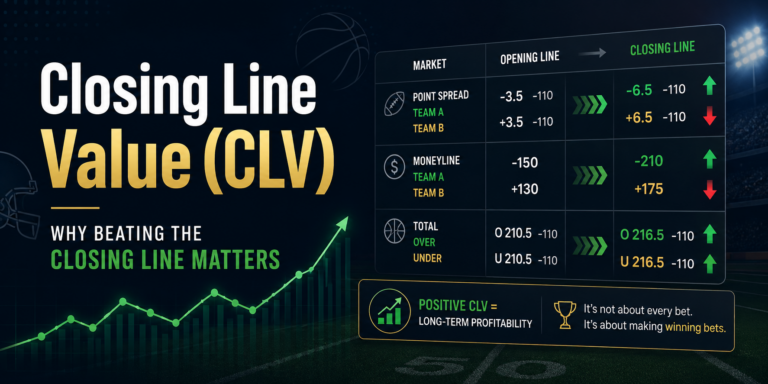
What Is Closing Line Value?
Closing line value, commonly abbreviated CLV, compares the price a bettor obtained with the market price near closing.
For example, if you bet Team A +140 and the market eventually closes Team A +115, you obtained the better price.
The team can still lose. CLV does not determine the result of an individual wager. Instead, it can help evaluate whether a bettor is repeatedly obtaining favorable prices compared with the broader market.
Read our full guide to Closing Line Value (CLV) in Sports Betting for examples, calculation methods, positive vs. negative CLV, no-vig analysis, and tracking methods.
You can also join the CLV discussion in the StatWagering forum.
Why Closing Prices Matter
Betting markets process information throughout the day. Prices may react to injuries, lineup changes, weather, starting pitchers, public betting, professional action, news, limit increases, and market consensus.
The closing line often contains more accumulated information than an early line. That is why consistently beating the closing price can be an interesting measure of betting process.
What Is Line Movement?
Line movement occurs when a sportsbook changes its odds, spread, or total.
For example, a point spread might move from Team A -3 to Team A -4, or a moneyline might move from -130 to -150.
The movement shows that the market price changed, but it does not automatically prove why. Understanding the distinction between observable line movement and assumptions about its cause is important.
What Is Sharp Money?
The term sharp money generally refers to betting activity associated with skilled or sophisticated market participants.
However, bettors should be cautious about overly simplistic interpretations. You cannot always determine who placed a wager merely by looking at bet percentages, handle percentages, or line movement.
Sharp-money analysis is best treated as one signal rather than unquestionable proof of what professional bettors are doing.
Public Betting and Market Bias
Casual bettors may be more attracted to famous teams, high-scoring offenses, favorites, overs, recent winning streaks, nationally televised games, and popular players.
These preferences can sometimes affect pricing. The analytical question is not whether the public is wrong. It is whether public demand causes the market price to differ from the underlying probability enough to create value elsewhere.
Sportsbook Vig and the Cost of Betting
Sportsbooks generally include a margin in their odds. This is commonly called vig, vigorish, juice, or hold.
A common point-spread market might show Team A -110 and Team B -110. At -110, a bettor must win approximately 52.38% of wagers to break even.
A long-term strategy must overcome both uncertainty and the sportsbook's pricing margin.
Why Line Shopping Matters
Suppose one sportsbook offers -110 and another offers -105 on the exact same wager. The difference may seem small, but across hundreds or thousands of bets, consistently obtaining the better price can materially improve ROI.
The same applies to spreads and totals. Getting +3.5 instead of +3 can occasionally turn a loss into a push or a push into a win.
Bankroll Management
Even a profitable betting approach can experience significant drawdowns. Bankroll management determines how much capital is risked on each wager.
Common approaches include flat betting, percentage-of-bankroll betting, fractional Kelly strategies, and fixed-unit betting.
The goal is not to eliminate losses. Losses are inevitable. The goal is to avoid allowing normal variance to create catastrophic bankroll damage.
Flat Betting
Flat betting means risking approximately the same amount or the same unit size on each wager.
Advantages include simplicity, easier performance evaluation, less emotional sizing, and reduced danger of dramatically increasing stakes after losses.
Why Chasing Losses Is Dangerous
A common behavioral mistake is increasing wager size simply because previous bets lost.
The problem is that prior losses do not automatically increase the probability that the next wager will win. Rapidly increasing stakes can expose a bankroll to enormous risk during an ordinary losing streak.
Track Every Bet
Accurate records are essential.
A useful betting log can include date, sport, matchup, selection, bet type, odds, stake, result, net units, sportsbook, opening line, closing line, and notes.
This makes it possible to calculate ROI, win rate, average odds, drawdowns, performance by sport, performance by wager type, and closing line value.
Evaluate Performance by Market
Overall results can hide important differences. A bettor might have strong ROI in MLB moneylines, weak results in totals, positive performance in NFL spreads, and poor results in parlays.
Breaking results into categories helps identify where a process appears strongest and where it may need improvement.
Beware of Overfitting Betting Systems
Historical betting systems can be useful research tools, but a system should not be considered meaningful simply because it produced excellent historical results.
Ask whether there is a logical explanation, whether the sample is large enough, whether the result persists across seasons, whether it survives out-of-sample testing, whether the effect is economically meaningful, and whether the result could simply be random.
Correlation Is Not Always Causation
Sports betting databases can reveal interesting relationships, but a historical relationship does not automatically mean one factor caused another.
Finding a pattern is the beginning of analysis, not the end. A stronger approach asks why the pattern might exist and whether that explanation remains plausible going forward.
Avoid Evaluating a Strategy by One Game
A well-researched wager can lose. A poorly researched wager can win.
The result of one game cannot tell you whether the decision was good. Instead, ask whether the price was favorable, whether the market moved toward or away from the number, whether the probability assessment was reasonable, whether the stake was appropriate, and whether the process holds up across many similar wagers.
A Sports Betting Learning Path
Step 1: Learn the wager types
Understand moneylines, spreads, totals, parlays, props, futures, run lines, and other basic markets.
Read: Types of Sports Bets Explained
Step 2: Learn how odds represent probabilities
Practice converting American odds into break-even probabilities.
Step 3: Understand value
Learn why the most likely winner is not always the best wager.
Step 4: Track performance
Measure profit, units, sample size, and return on investment.
Read: Sports Betting ROI: Formula, Examples & How to Calculate It
Step 5: Study market movement
Learn how prices move between opening and closing.
Step 6: Understand closing line value
Compare your betting prices with the closing market.
Read: What Is Closing Line Value (CLV) in Sports Betting?
Discuss: What Is Closing Line Value (CLV) and Why Does It Matter?
Step 7: Build disciplined records
Analyze performance by sport, bet type, price range, and market.
Step 8: Research patterns carefully
Use historical data without assuming every profitable backtest represents a real edge.
Sports Betting Education FAQ
What should a beginner learn first about sports betting?
Start with wager types and odds. Learn what a moneyline, spread, total, prop, and parlay are before moving into more advanced topics such as expected value and closing line value.
Is sports betting mostly about predicting winners?
No. Prediction matters, but price matters just as much. A likely winner can be a poor wager if the sportsbook price is too expensive.
What is the most important sports betting statistic?
There is no single perfect metric. ROI, units, sample size, average odds, and closing line value each provide different information.
What does +EV mean in sports betting?
+EV means positive expected value. It describes a wager where the estimated probability suggests the offered price is favorable over repeated trials.
What is a good sports betting ROI?
There is no universal benchmark. A modest positive ROI across thousands of documented wagers can be much more meaningful than a huge ROI across a small sample.
Does beating the closing line guarantee profits?
No. Closing line value can provide information about price quality, but it does not guarantee that individual bets or short-term samples will win.
Why do sportsbooks use -110 odds?
The additional cost above even money provides part of the sportsbook's built-in margin. At -110, a bettor must win about 52.38% to break even.
Should beginners bet parlays?
Parlays are easy to understand but have higher variance and require multiple selections to win. Learning straight bets first makes it easier to understand pricing and performance.
Why should I track every wager?
Accurate records allow you to calculate ROI, units, win percentage, average odds, drawdowns, and performance by market instead of relying on memory.
Final Thoughts
The most useful sports betting education does not revolve around finding guaranteed winners. There are no guaranteed winners.
A more durable approach is to understand sports betting as a market involving probability, price, risk, expected value, market movement, performance measurement, and discipline.
Learn how wager types work. Understand what odds imply. Measure your actual ROI. Track whether you obtain favorable prices. Study closing line value. Keep accurate records. And evaluate decisions across meaningful samples rather than judging an entire process by whether tonight's game won or lost.