Types of Sports Bets Explained: A Complete Guide to Wager Types
Sports betting offers far more options than simply picking which team will win. Understanding the different types of sports bets is one of the first steps toward evaluating odds, comparing prices, and making more informed wagering decisions.
The most common wager types include moneylines, point spreads, totals, run lines, puck lines, prop bets, futures, parlays, teasers, and round robins. Each works differently and creates a different relationship between probability, payout, and risk.
This guide explains the major sports betting wager types, how they work, and how to read them using practical examples.
What Are the Main Types of Sports Bets?
Although sportsbooks may offer hundreds of individual markets, most wagers fall into a relatively small number of categories:
- Moneyline
- Point spread
- Over/under total
- Run line
- Puck line
- Prop bet
- Futures bet
- Parlay
- Same-game parlay
- Teaser
- Round robin
- First-half and first-period bets
- Alternate lines
Understanding these basic structures makes it much easier to evaluate almost any betting market.
Moneyline Bets
A moneyline bet is a wager on which team or competitor will win the event. There is no point spread involved.
A typical matchup might look like:
Chicago +140
New York -160
The negative number indicates the favorite, while the positive number indicates the underdog. At American odds of -160, you would need to risk $160 to win $100 in profit. At +140, a $100 wager would return $140 in profit if the underdog won.
Moneylines are common in MLB, NHL, tennis, MMA, and boxing. They are also available in football and basketball, although point spreads often receive more attention in those sports.
Why Moneyline Price Matters
Picking the winner is only part of the decision. Suppose a baseball team wins 60% of the time. That does not automatically make it a good bet at any price.
A bettor should compare the probability implied by the odds with an estimate of the team's true probability of winning. That distinction between who is likely to win and whether the price offers value is fundamental to sports betting analysis.
Point Spread Bets
A point spread gives one team a virtual advantage or disadvantage before the game begins.
For example:
Kansas City -3.5
Denver +3.5
A wager on Kansas City -3.5 wins if Kansas City wins the game by 4 or more points. A wager on Denver +3.5 wins if Denver wins outright or loses by 3 points or fewer.
Point spreads are especially common in the NFL, college football, NBA, and college basketball.
What Does -110 Mean on a Spread?
Many traditional spread bets are priced near -110. At -110 odds, a bettor risks $110 to win $100.
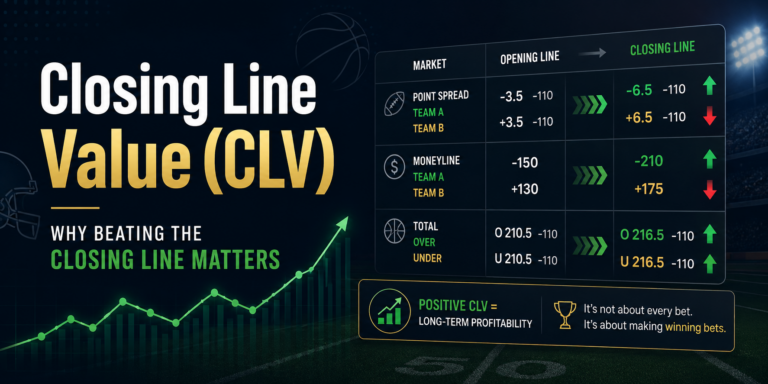
Spreads do not always remain -110 on both sides. Sportsbooks can adjust the price before moving the actual point spread. Monitoring both the spread and the accompanying price can provide information about how a betting market is moving.
Over/Under or Total Bets
A total, commonly called an over/under, is a wager on the combined score of both teams.
Example: Green Bay vs. Chicago — Total 44.5
A bet on Over 44.5 wins if the teams combine for 45 or more points. A bet on Under 44.5 wins if they combine for 44 or fewer.
Totals are offered across nearly every major sport, including football points, baseball runs, hockey goals, and basketball points. Sportsbooks also offer totals for individual teams, halves, periods, quarters, innings, and players.
Run Line Bets in Baseball
MLB uses a spread-style wager known as the run line. The traditional run line is Favorite -1.5 / Underdog +1.5.
If the Yankees are -1.5, they must win by at least two runs for that wager to cash. If the opposing team is +1.5, it can either win the game or lose by exactly one run.
Unlike a typical football spread, run-line prices can vary considerably because a 1.5-run adjustment changes the probability substantially.
Puck Line Bets in Hockey
The NHL equivalent of baseball's run line is the puck line. The standard puck line is generally Favorite -1.5 goals / Underdog +1.5 goals.
Because many NHL games are decided by a single goal, puck-line pricing can differ significantly from the game's moneyline.
Prop Bets
A proposition bet, or prop bet, focuses on an outcome other than simply the final score.
Player props might include quarterback passing yards, pitcher strikeouts, batter home runs, basketball player points, or hockey player shots on goal. Game props might include which team scores first, first-half result, first inning run scored, or first touchdown scorer.
Futures Bets
A futures wager is placed on an outcome that will be decided later in a season or tournament.
Examples include the Super Bowl winner, World Series winner, NBA champion, Stanley Cup winner, conference champion, division winner, league MVP, or season win total.
One important consideration is that money committed to a futures bet generally remains tied up until the market settles. The odds can also change dramatically during a season as injuries, performance, standings, and market expectations change.
Parlays
A parlay combines multiple bets into one wager. Every selection generally must win for the parlay to cash.
For example: Baltimore moneyline + Dallas -3 + Chicago/New York Under 45.
The attraction is a larger potential payout. The tradeoff is that the probability of winning decreases as more selections are added.
Why Parlay Payouts Grow Quickly
Suppose two independent wagers each have a 50% chance of winning. The probability that both win is 25%. Three independent 50% events have a combined probability of 12.5%.
This is why parlays can produce attractive-looking payouts while still being difficult to win consistently.
Same-Game Parlays
A same-game parlay, often abbreviated SGP, combines several selections from one game. Because same-game outcomes can be correlated, sportsbooks account for those relationships when calculating the final price.
Teaser Bets
A teaser resembles a parlay but allows the bettor to adjust point spreads or totals in exchange for a reduced payout.
A football teaser might move Buffalo -7.5 to Buffalo -1.5 and Dallas +2 to Dallas +8. Both selections still need to cover the adjusted spreads for a standard two-team teaser to win.
Round Robin Bets
A round robin automatically creates multiple smaller parlays from a group of selections.
For four teams A, B, C, and D, a two-team round robin creates A+B, A+C, A+D, B+C, B+D, and C+D.
Instead of needing all four selections to win one large parlay, you have six separate two-team parlays.
First-Half, Quarter, Period and Inning Bets
Sportsbooks increasingly divide games into smaller betting markets. Football and basketball commonly offer first-half, second-half, and quarter lines. Baseball offers first-five-inning and first-inning markets. Hockey offers period betting.
These markets can behave differently from full-game lines because they cover shorter samples and different strategic situations.
Alternate Lines
Many sportsbooks allow bettors to select an alternate spread or total.
Suppose the standard NFL line is Team A -6.5 -110. Alternate choices might include Team A -3.5 at a more expensive price or Team A -9.5 at a larger potential payout.
The bettor is effectively exchanging probability for price.
What Is the Difference Between Odds and the Wager Type?
The wager type describes what you are betting on. The odds describe the price being offered on that wager.
For example, in Detroit moneyline +125, “moneyline” is the wager type and “+125” is the price.
Which Type of Sports Bet Is Best?
There is no universally best wager type. The important question is whether the offered price accurately reflects the probability of the outcome.
A bettor might specialize in MLB moneylines, NFL point spreads, NBA totals, NHL puck lines, player props, or futures. More complicated wager structures do not automatically create better opportunities.
Wager Type vs. Betting Value
Understanding wager types is only the beginning. Long-term sports betting analysis ultimately comes down to the relationship between probability and price.
Consider two hypothetical bets. Bet A has a 60% chance to win, but the sportsbook price implies a 70% probability. Bet B has a 45% chance to win, but the price implies only a 40% probability. Bet A involves the more likely winner, while Bet B may offer the better wagering value.
This is why serious betting analysis focuses on more than win probability. Other concepts worth understanding include expected value, implied probability, return on investment, closing line value, market movement, and bankroll management.
For more on long-term performance measurement, see our sports betting ROI guide. You can also explore our sports betting education resources and our forum discussion on closing line value (CLV).
Sports Betting Wager Types FAQ
What is the easiest sports bet to understand?
The moneyline is generally the simplest. You are betting on which team or competitor will win.
What does -110 mean?
At American odds of -110, you risk $110 to win $100 in profit.
What does +150 mean?
At +150 odds, a $100 winning wager generates $150 in profit, plus the original stake is returned.
What is the difference between a moneyline and a point spread?
A moneyline is based on who wins the game. A point spread is based on the margin of victory after applying the sportsbook's spread.
What is an over/under?
An over/under is a wager on whether a combined score or statistical result will finish above or below a number set by the sportsbook.
What is a parlay?
A parlay combines multiple selections into one bet. Each selection generally must win for the traditional parlay to cash.
What is a prop bet?
A prop bet is a wager on a specific event or statistic rather than simply the game's final result.
What are run lines and puck lines?
A run line is baseball's common spread market, while a puck line is hockey's equivalent.
Final Thoughts
Understanding the different types of sports bets gives bettors the vocabulary needed to analyze a sportsbook properly.
The major wager types include moneylines, spreads, totals, run lines, puck lines, props, futures, parlays, teasers, and round robins. Each changes the probability, payout, or condition required for a wager to win.
The next step is learning how to evaluate the price attached to those bets. Knowing how a moneyline works is useful. Knowing whether the moneyline represents value is far more important.